How to Open a Bakery in the Philippines and Why it is a Good Business
Key takeaways:
- Starting a bakery in the Philippines presents strong opportunities due to the high demand for various baked goods.
- Key advantages include creative freedom, community engagement, and growth potential.
- However, challenges like competition and the risk of failure exist.
- Success requires careful planning, market research, and securing necessary permits.
- Capital requirements range from Php 50K to Php 500K.
- Understanding the market and choosing between franchising or creating a brand are essential first steps.




Table of Contents

In the Philippines, bread is a widely loved food that plays a significant role in the nation’s culture and identity. Local bakers have developed various types of Filipino bread that reflect influences from Spanish, Chinese, and American culinary traditions. The variety of bread products is incredibly diverse, and every type is in high demand. The retail sales of the baking industry in the country are projected to increase by 5% each year, reaching $2.5 billion (1) by 2027. This indicates a strong business opportunity.
Let’s examine the important factors that should be taken into account to ensure the success of this venture.
- 0% interest for first loan
- Apply with 1 valid ID only
- 5 minute application and approval

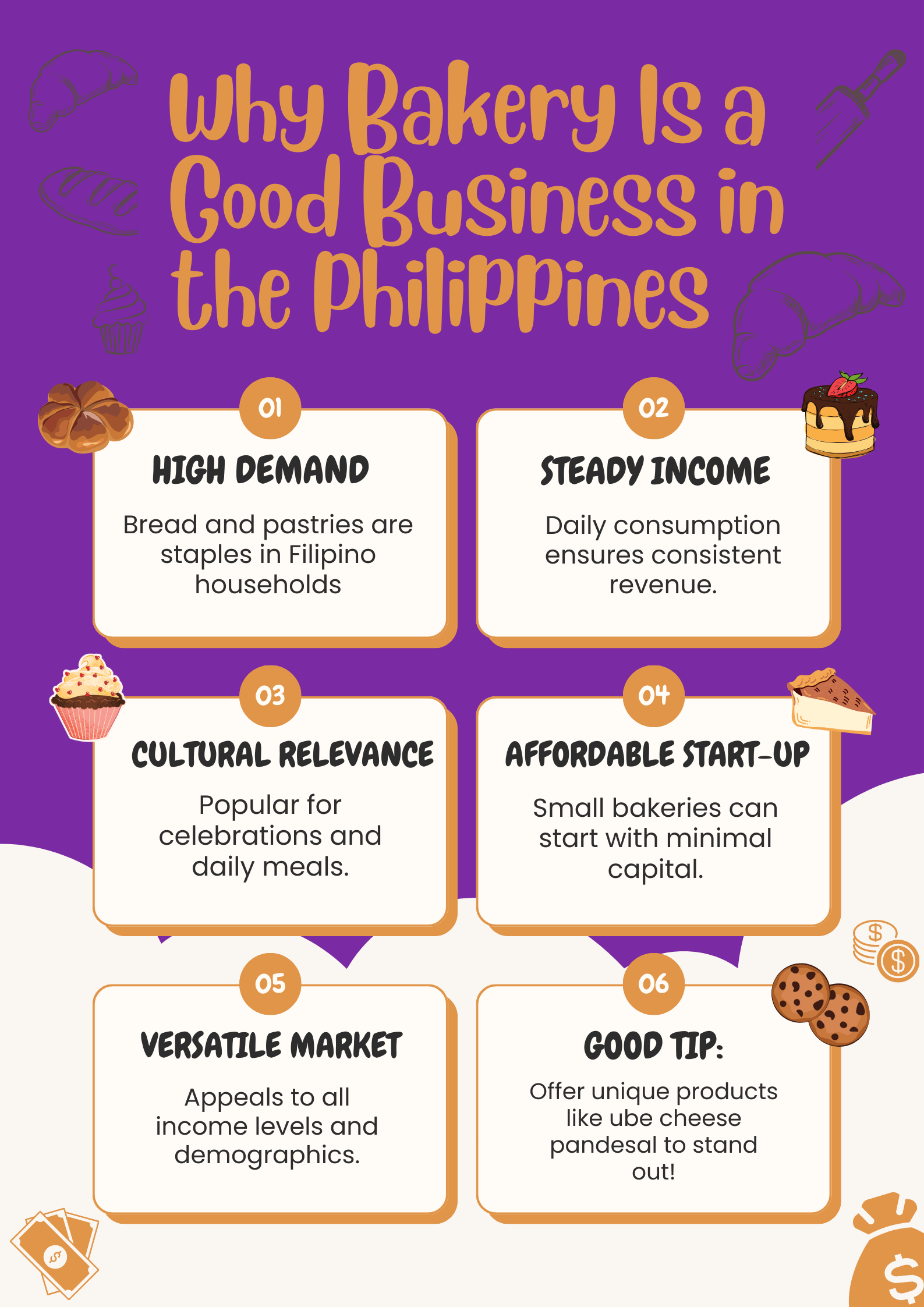
Why Bakery Is a Good Business in the Philippines
Here are the key reasons:
- Bread is a favorite food among Filipinos, ensuring that there will always be demand for it.
- The market for this product continues to grow each year.
- Bread appeals to a wide range of customers, from everyday workers to those seeking more sophisticated baked goods, such as dessert breads.
- Bread snacks are popular in both economically stable and challenging times.
- This high demand creates a substantial market, allowing you to study numerous examples and avoid many common rookie mistakes.
Bakery Business in the Philippines: Pros and Cons
Let us consider the advantages of this type of enterprise:
- High demand for baked goods. The Filipino market has a strong appetite for baked products, including bread, pastries, and cakes. This demand is driven by cultural habits, as baked goods are often consumed during meals and special occasions.
- Freedom for creativity. Owning a bakery allows for significant creative expression. Bakers can experiment with recipes, create unique products, and develop their brand identity. This can lead to customer loyalty as clients return for signature items.
- Community engagement. Bakeries often serve as community hubs where people feel a personal connection to the owner and the products. This relationship can foster loyalty and repeat business, enhancing the bakery’s reputation within the neighborhood.
- Potential for growth. Starting small with a home-based or local bakery can lead to expansion opportunities. As demand grows, bakers can scale their operations, introduce new product lines, or even open additional locations.
- Flexibility in operations. Bakery owners have control over their schedules and operations, allowing them to balance personal commitments with business demands. This flexibility can be appealing to those seeking independence in their work life.
As for the disadvantages of the bakery business, they are as follows:
- High competition. With many bakeries already in operation, opening a new one means facing considerable challenges.
- Considerable requirements for the entrepreneur. Besides the initial investment, you must also dedicate significant time, commitment, and patience to overcome challenges. Those who enter the bakery business without a genuine passion for baking often do not succeed.
- Risk of failure. While many people dream of starting their own business, not everyone succeeds in building a solid enterprise. If you are new to entrepreneurship, it is advisable to start on a smaller scale.
How to Launch a Successful Bakery Business in the Philippines
- Imagine One Day as a Bakery Owner
Picture your workday in your own business and ask yourself whether you are willing to spend your hours in the bakery, engaging with employees and customers, managing suppliers, reviewing the balance sheet, and more. Decide if you are prepared to dedicate your time and energy to this venture.
- Consider Taking Bakery Courses
Enroll in baking courses, even the shortest ones, to learn how to distinguish a quality product from a subpar one and grasp the essential fundamentals of baking. Pay particular attention to pandesal baking, as it is one of the most popular types of bread.
Here are three online courses along with their tuition fees.
| Course | Duration | Tuition fee |
|---|---|---|
| The Bread and Pastry Production by Home Culinary and Pastry School | 10 days | Php 46,800 |
| Basic Baking Class by Maya Kitchen | 4 days | Php 8,000 |
| Part-time in Pastry & Bakery Arts by Academy of Pastry and Culinary Class | 12 weekends | Php 67,000 |
- Identify Point B for Your Business
Establish a clear vision for your business over the next one, three, or five years. Consider the desired scale of operations and the profit margins you aim to achieve. This foresight will facilitate informed decision-making regarding the subsequent steps in the development of your bakery.
- Define Your Target Audience and Conduct Market Research
Reflect on whether you intend to cater to an affluent clientele with premium products, such as French bread, or offer more accessible items to a broader demographic. This decision will influence your choice of location, product offerings, and marketing strategies for your bakery.
Based on your target audience, identify your competitors and analyze their product offerings.
- Decide Between Establishing Your Own Bakery or Purchasing a Franchise
In the Philippines, there are 12,750 bakery and cake shops (2), with 95.23% operating as single-owner establishments, while the remaining 639 (4.77%) are affiliated with larger brands. While opening a franchise may present a safer option for newcomers, it is essential to weigh both the advantages and disadvantages associated with this choice.
| Aspect | Franchise | Your own venture |
|---|---|---|
| Business model | Franchises provide a well-tested business model that has shown success. | There may be limited opportunities for you to implement your own methods. |
| Brand awareness | Franchises come with built-in brand recognition, which means customers are already familiar with the brand. This can also help in attracting team members. | Your business may suffer if other franchise owners make mistakes that harm the brand’s reputation. |
| Decision-making | As a franchise owner, you have the authority to make important decisions, hire staff, and ensure product quality. | The franchisor has the final say on significant matters. |
| Access to expertise | You may excel in sales or leadership, but running a business involves many complexities. While your strengths are beneficial, having access to experts can be very helpful. | – |
| Financial state | During the application process, you will learn about the franchisor’s financial performance, which can aid in your planning. | Positive average figures for franchises do not guarantee quick profits for every new location without considerable effort initially. |
| Operational Support | Franchisors provide operational support. | It may not always allow for your own solutions and tools within their established systems. |
| Marketing Support | You do not need to create your own branding elements such as logos and taglines. | Your creativity might be limited by the franchisor’s guidelines. |
| Training | Franchisors may offer training tailored for you and your staff. | You must follow the training protocols set by the franchisor. |
| Growth prospects | Franchises can offer growth opportunities by allowing you to open additional locations. | You need permission from the franchisor to do so. |
| Quality assurance | Franchisors are knowledgeable about federal and provincial regulations and maintain their own product quality standards. With a good franchisor, you will receive tools and guidance to help you meet these standards. | You are responsible for ensuring quality on your own. |
| Supply chain | Franchises benefit from lower prices due to large order volumes negotiated by the franchisor. | You must use the suppliers chosen by your franchisor. |
- Pick your format
Now, it is the time to select the right format for your bakery business. The main options include traditional bakeries, bakery cafes, ghost kitchens (delivery-only bakeries), and food trucks.
🥨 Counter Style
This format is ideal for those with limited space, as counter-style bakeries typically do not include dining areas, focusing solely on to-go orders. While this may restrict sales volume, it also reduces overhead costs.
🥨 Bakery Cafe
In contrast to counter-style bakeries, bakery cafes provide seating for customers, requiring larger front-of-house and back-of-house spaces. This format necessitates hiring additional staff and offers a broader menu that includes beverages and potentially larger meals. Besides, it comes with higher setup and operational costs.
🥨 Home Bakery
For those not ready to invest in a commercial space, a home bakery is a viable option. It requires less startup capital since there is no need for extra space or furniture. This format encourages the use of online platforms for customer outreach and is suitable for individuals who already have baking experience and equipment.

🥨 Food Truck
Although less common in the Philippines, food trucks present a cost-effective and mobile alternative to home bakeries. They allow bakers to reach customers directly at various locations, such as fairs and events. However, the limited space in food trucks may restrict the baking area and menu options, necessitating pre-preparation of baked goods.
🥨 Ghost Kitchens
A ghost kitchen operates primarily through digital channels, with minimal customer interaction occurring during order placement and delivery. This model focuses exclusively on fulfilling online food orders, benefiting from the increasing demand for delivery services.
Did You Know Why a Croissant Is Called a Croissant? The word croissant comes from the French word for “crescent,” inspired by its iconic crescent moon shape. This flaky pastry’s name traces back to its origins in Vienna, where it was first baked as the kipferl to celebrate a military victory over the Ottoman Empire. Legend has it that the crescent shape was chosen as a nod to the symbol on the Ottoman flag. When the recipe made its way to France, it was refined into the buttery, layered delight we know today, earning its now-famous French name.

- Find the Right Location
Upon identifying your target audience, it is imperative to ascertain the locations where this audience resides, works, or frequently visits. The volume of customer traffic in the chosen location for your bakery is a critical factor. It is advisable to avoid opening in areas with excessive competition. Let’s take a look at the actual figures.
The location of your bakery will significantly influence the potential success of your business. The following factors should be considered when selecting a point of sale:
- The ease of access for customers is paramount in determining the optimal location for a bakery. Establishing your business in a high-traffic area can present a valuable opportunity.
- It is essential to secure a location that is financially viable while simultaneously attracting a substantial volume of customers, thereby balancing operational expenses with potential revenue.
- Analyzing the competitive landscape is crucial when assessing potential bakery locations. It is advisable to establish your business in areas where there is sufficient demand for baked goods but not an overwhelming number of competing bakeries.
- Understanding the demographics of the area will provide insights into your potential customer base, including their age, income levels, and preferences.
- Investigating regions with growing populations and increasing economic activity can significantly enhance the prospects for success in your bakery venture.
- Accessibility to essential utilities such as water, electricity, and gas is vital for the efficient operation of your bakery.
Learn all about:
The 20 Most Profitable Small Businesses you can Start in the Philippines
- Consider the Best Price for Each Item in Your Product Line
Determine the appropriate price for each item based on the revenue you need to generate. Calculate the amount and cost of ingredients, along with any additional expenses such as labor and utilities. From these calculations, establish the selling price required to ensure your products are profitable. Consider that the profit margins for a bakery business are generally considered to be moderate, typically ranging from 25% to 50% in terms of gross margin.
- Obtain All Necessary Requirements
To operate a bakery business in the Philippines, you will need the following permits and certifications:
- Register your business name with the Department of Trade and Industry (DTI) if you are a sole proprietor, or with the Securities and Exchange Commission (SEC) if your bakery is a partnership or corporation.
- Acquire a Mayor’s Permit or Residence Certificate and a Sanitary Permit from the local municipality where your bakery is located.
- Obtain a License to Operate (LTO) as a “food manufacturer” or a BFAD Certificate from the Bureau of Food and Drugs (BFAD).
- Get a Tax Identification Number (TIN) from the Bureau of Internal Revenue.
Learn more:
Best Small Business Franchises in the Philippines
- Purchase Bakery Equipment and Hire People
You will need baking trays, a bread crusher, a bakery oven, a dough mixer, and a bread slicer to fully equip your bakery. Initially, your bakery can operate with just one person — the owner. It is not necessary to hire many employees right away to avoid unnecessary costs.
Learn How to Get:
Startup Business Loans Without Collateral in the Philippines: Personal Loan Options
- Start Promoting Your Business
Distribute flyers to people passing by your bakery, especially near public transport stations, shopping centers, and busy areas. Utilize free online advertising platforms to present help to your business.
Fast Online Loans from Digido for Your Great Business Ideas
Whatever format, size, and location of the bakery you choose, you can always count on fast financial support from Digido. There are no hidden charges, upfront fees, or commissions associated with its services, ensuring complete transparency.
The loan application process is designed to be straightforward and efficient, allowing for instantaneous decisions on applications. Clients can choose from multiple modes of loan application, including its website, mobile application, and in-person visits to its branches, ensuring convenience and accessibility. With a loan approval rate exceeding 90%, Digido is dedicated to supporting the financial aspirations of business owners.
* Interest payments are approximate. The final loan amount and interest rate must be confirmed in your loan agreement after loan approval.
Learn more:
Beyond the 9-to-5 Grind: 25 Best Side Hustles in the Philippines
Conclusion
The bakery niche in the Philippines is steadily growing, as bread is one of the favorite foods. However, whether in this field or any other, a budding entrepreneur must recognize that the road to success can be challenging, especially in such a competitive market. Carefully considering each step can help you avoid rookie mistakes and save a significant amount of money.
FAQ
-
What types of bread do Filipinos enjoy at different times of the day?For breakfast, they typically savor pandesal and monay alongside a steaming cup of coffee. During merienda (morning snack), they often indulge in sweeter bread options such as ensaymada, mamon, cheese bread, and pan de coco, paired with a chilled bottle of their favorite soft drink
-
Why do many entrepreneurs prefer to open a bakery independently rather than buy a franchise?Purchasing a franchise requires a significant investment, so aspiring entrepreneurs often opt for alternatives such as a home bakery, a small van, or renting a space in someone else's dark kitchen.
-
Can I obtain a loan to open a bakery?Yes, you can secure a loan from both banks and private lenders for business purposes.
-
What is the most popular type of bread, and where can I find sellers?Masa, the classic Filipino bread, is a well-established best-seller.
-
How much money do I need to start a bakery business in the Philippines?In general you will need substantial capital, ranging from Php 50K to Php 500K, to launch this type of business.

Authors


Download our app
- Borrowing 24/7
- Approval rate over 90%
- 1 Valid ID